The post Walking the tightrope of multicloud networks appeared first on B6G.NET| for all information technology.
]]>Multi-cloud, and the connectivity that underpins it, are now critical to business success, enabling new opportunities, improving resource efficiency and increasing business agility. It’s an open secret that companies deploying more than one public cloud are more likely to see revenue growth than those just embarking on a cloud migration journey, or maybe still relying heavily on public cloud services. internal solutions.
This does not mean that there are no difficulties associated with multi-cloud. Nothing is further from reality. For starters, there’s the tricky business of choosing the correct mix of clouds and the right tools to support that mix. There is the question of the interconnection of the different clouds. CIOs also need to determine where it’s best to apply the cloud and where it makes sense to keep business information on-premises, perhaps for regulatory reasons. There are issues of scalability, risk management and digital sovereignty. You have to weigh the cost benefits against the known and unknown security challenges that are certainly lurking just around the corner.
That’s why it’s important for the CIO to pay attention to advances in the kind of technology that can make sense of multi-cloud and turn overwhelming complexity into manageable simplicity. Using cloud-native connectivity, for example, gives organizations not only better control of cloud environments, but also gives them a head start in exploiting new opportunities, integrating applications, and making the most of cloud computing. third party software and services. A cloud-native approach to networking and application development facilitates better collaboration with partners and customers, and generally leads to a more interconnected digital infrastructure.
To dig deeper into these issues, check out this upcoming March 23 multi-cloud and cloud-native networking event online . The event will be led by Brad Casemore, research vice president of data center and multi-cloud networks at consulting firm IDC. And so that international media attending the event don’t miss out, Casemore will present new data from its upcoming forecast on multicloud networks.
He will be joined by a panel of main industry experts, in a discussion that will explore the benefits of a cloud-native approach to cloud connectivity issues. The smartest approaches to choosing the right cloud solution for the right application will be considered.
The following speakers will participate in the event
- Brad Casemore , Research Vice President, Data Center and Multicloud Networks at IDC Consulting
- Sreekanth Kannan , Vice President of Product Management and Marketing, Arrcus
- Jim Brinksma , Chief Technology Officer of Megaport
- Ranga Rajagopalan , Vice President and Chief Architect at VMware
vmware.com - Bryan Ashley, Vice President of Solutions Management & Marketing, Aviatrix
By Guy Matthews, NetReporter Publisher
The post Walking the tightrope of multicloud networks appeared first on B6G.NET| for all information technology.
]]>
The post Cytrox’s Predator Spyware Targeted Android Users with Zero-Day Exploits appeared first on B6G.NET| for all information technology.
]]>
Google’s Threat Analysis Group (TAG) on Thursday pointed fingers at a North Macedonian spyware developer named Cytrox for developing exploits against five zero-day (aka 0-day) flaws, four in Chrome and one in Android, to target Android users.
“The 0-day exploits were used alongside n-day exploits as the developers took advantage of the time difference between when some critical bugs were patched but not flagged as security issues and when these patches were fully deployed across the Android ecosystem,” TAG researchers Clement Lecigne and Christian Resell said.
Cytrox is alleged to have packaged the exploits and sold them to different government-backed actors located in Egypt, Armenia, Greece, Madagascar, Côte d’Ivoire, Serbia, Spain, and Indonesia, who, in turn, weaponized the bugs in at least three different campaigns.
The commercial surveillance company is the maker of Predator, an implant analogous to that of NSO Group’s Pegasus, and is known to have developed tools that enables its clients to penetrate iOS and Android devices.
In December 2021, Meta Platforms (formerly Facebook) disclosed that it had acted to remove roughly 300 accounts on Facebook and Instagram that the company used as part of its compromise campaigns.
The list of the five exploited zero-day flaws in Chrome and Android is below –
According to TAG, all the three campaigns in question commenced with a spear-phishing email that contained one-time links mimicking URL shortener services that, once clicked, redirected the targets to a rogue domain that dropped the exploits before taking the victim to an authentic site.
“The campaigns were limited — in each case, we assess the number of targets was in the tens of users,” Lecigne and Resell famous. “If the link was not active, the user was redirected directly to a valid website.”
The final goal of the operation, the researchers assessed, was to distribute a malware dubbed Alien, which acts as a precursor for loading Predator onto infected Android devices.
The “simple” malware, which receives commands from Predator over an inter process communication (IPC) mechanism, is engineered to record audio, add CA certificates, and hide apps to evade detection.

The first of the three campaigns took place in August 2021. It used Google Chrome as a jumping off point on a Samsung Galaxy S21 device to force the browser to load another URL in the Samsung Internet browser without requiring user interaction by exploiting CVE-2021-38000.
Another intrusion, which occurred a month later and was delivered to an up-to-date Samsung Galaxy S10, involved an exploit chain using CVE-2021-37973 and CVE-2021-37976 to escape the Chrome sandbox (not to be confused with Privacy Sandbox), leveraging it to drop a moment exploit to escalate privileges and deploy the backdoor.
The third crusade — a full Android 0-day exploit — was detected in October 2021 on an up-to-date Samsung phone running the then latest version of Chrome. It strung together two flaws, CVE-2021-38003 and CVE-2021-1048, to escape the sandbox and compromise the system by injecting malicious code into privileged processes.
Google TAG pointed out that while CVE-2021-1048 was fixed in the Linux kernel in September 2020, it wasn’t backported to Android until final year as the fix was not marked as a security issue.
“Attackers are actively looking for and profiting from such slowly-fixed vulnerabilities,” the researchers said.
“Tackling the harmful practices of the commercial surveillance industry will require a robust, comprehensive approach that includes cooperation among threat intelligence teams, network defenders, academic researchers and technology platforms.”
The post Cytrox’s Predator Spyware Targeted Android Users with Zero-Day Exploits appeared first on B6G.NET| for all information technology.
]]>The trojan, so named for carrying out denial-of-service attacks on Linux systems and its use of XOR-based encryption for communications with its command-and-control (C2) server, is known to have been active since at least 2014. "XorDdos' modular

The post Microsoft Warns Rise in XorDdos Malware Targeting Linux Devices appeared first on B6G.NET| for all information technology.
]]>
A Linux botnet malware known as XorDdos has witnessed a 254% surge in activity over the last six months, according to latest research from Microsoft.
The trojan, so named for carrying out denial-of-service attacks on Linux systems and its use of XOR-based encryption for communications with its command-and-control (C2) server, is known to have been active since at least 2014.
“XorDdos’ modular nature provides attackers with a versatile trojan capable of infecting a variety of Linux system architectures,” Ratnesh Pandey, Yevgeny Kulakov, and Jonathan Bar Or of the Microsoft 365 Defender Research Team said in an exhaustive deep-dive of the malware.
“Its SSH brute-force attacks are a relatively simple yet effective technique for gaining root access over a number of potential targets.”
Remote control over vulnerable IoT and other internet-connected devices is gained by means of secure shell (SSH) brute-force attacks, enabling the malware to form a botnet capable of carrying distributed denial-of-service (DDoS) attacks.

Besides being compiled for ARM, x86, and x64 architectures, the malware is designed to support different Linux distributions, not to mention come with features to siphon touchy information, install a rootkit, and act as a vector for follow-on activities.
In a further sign that the malware could act as a conduit for other threats, devices originally breached with XorDdos are being subsequently infected with another Linux trojan called Tsunami, which then deploys the XMRig coin miner.
In recent years, XorDdos has targeted unprotected Docker servers with exposed ports (2375), using victimized systems to overwhelm a target network or service with fake traffic in order to render it inaccessible.

XorDdos has since emerged as the top Linux-targeted threat in 2021, followed by Mirai and Mozi, accounting for more than 22% of all IoT malware observed in the wild, per cybersecurity firm CrowdStrike.
“XorDdos uses evasion and persistence mechanisms that allow its operations to remain robust and stealthy,” the researchers noted.
“Its evasion capabilities include obfuscating the malware’s activities, evading rule-based detection mechanisms and hash-based malicious dossier lookup, as well as using anti-forensic techniques to break process tree-based analysis.”
The post Microsoft Warns Rise in XorDdos Malware Targeting Linux Devices appeared first on B6G.NET| for all information technology.
]]>The post Pluribus announces cooperation with NVIDIA on Unified cloud networks appeared first on B6G.NET| for all information technology.
]]>Pluribus has also announced its collaboration with industry leader NVIDIA to enable a critical aspect of the unified cloud network architecture. Pluribus has ported its proven Netvisor ONE operating system, widely deployed on data center switches around the world, to the NVIDIA BlueField-2 DPU , which offloads, accelerates and isolates data center infrastructure tasks, enabling that the Pluribus Unified Cloud Material extends to both switches and DPUs.
This solution harnesses the full power of the NVIDIA BlueField hardware accelerators and NVIDIA DOCA , the software development framework that powers BlueField. Initial use cases for the architecture include software-defined networking (SDN), unified and automated network fabrics with distributed security services, including micro-segmentation, distributed firewalls, and pervasive network visibility.
Cloud network operators of all kinds recognize the need to move to a new, more distributed, zero-trust security network architecture to address growing cybersecurity risks, while transforming their cloud networks to be as agile, highly available, and simple to function as hyperscale public clouds. Pluribus solutions built on Pluribus Unified Cloud Fabric, the next generation of the company’s award-winning Adaptive Cloud Fabric, enable cloud network operators to overcome the obstacles of their current surroundings and the shortcomings of existing solutions, so that can move quickly towards this goal.
The Pluribus Unified Cloud Networking and Unified Cloud Material architecture attributes include
- Unified and simplified cloud networks. Pluribus eliminates fragmented networks with separate operating models, enables a smooth migration to the new distributed architecture, and reduces complexity and operational costs by providing a consistent network operations model across underlying (physical) and overlay (virtual) networks, in switches and servers, and in heterogeneous and distributed clouds.
- Distributed security without compromise. Pluribus enables network security to be distributed at the server level, including fine-grained micro-segmentation and stateful distributed firewalls. Pluribus Unified Cloud Material enables considerably better performance and lower complete cost of ownership compared to hardware appliances or purely software-based solutions.
- Omnipresent visibility. Pluribus offers built-in visibility and analytics for every application and every traffic flow, improving proactive problem detection and resolution and eliminating the extra cost and incomplete coverage of separate monitoring networks.
- SDN-enabled automation. Pluribus solutions incorporate industry-leading controllerless SDN automation to enable network operations teams to administer highly distributed networks with thousands of DPUs and other network endpoints, while avoiding the challenges of integrating network automation tools. third parties or create and maintain DIY scripts.
- Accelerated SDN on the host. Running the Pluribus Unified Cloud Fabric on the NVIDIA BlueField DPU extends the power and flexibility of hardware-accelerated software-defined networking to all hosts with a DPU installed.
Pluribus Unified Cloud Material is the industry’s only solution that enables cloud operators to gracefully transform to the new highly distributed cloud network architecture with built-in security, visibility, and automation, proven mission-critical reliability, and radically simplified operations across cloud computing. distributed cloud networks. Compared to alternative solutions, Pluribus Unified Cloud Networking can also offer cost savings that add up to hundreds of thousands of dollars over a typical cloud data center.
Pluribus Unified Cloud Fabric is the industry’s only solution that enables cloud operators to gracefully transform to the new highly distributed cloud network architecture with built-in security, visibility, and automation, proven mission-critical reliability, and radically simplified operations across cloud computing. distributed cloud networks. Compared to alternative solutions, Pluribus Unified Cloud Networking can also offer cost savings that add up to hundreds of thousands of dollars over a typical cloud data center.
“The advances that Pluribus has made in its architecture in the last year reinforce that we are truly the Unified Cloud Networks company. Pluribus solutions significantly reduce complexity and enable enterprises and service providers to take full advantage of the distributed multi-cloud era. I am extremely proud that we have now achieved the industry’s only open, automated SDN solution that unifies the network across both data center switches and servers while maintaining security, automation, visibility and performance.” – Kumar Srikantan, CEO of Pluribus Networks.
“A new wave of technologies spanning AI, 5G and virtual worlds is being enabled by next-generation data centers, driving demand for accelerated computing and next-generation clouds with software-defined networking. Pluribus SDN technology running on NVIDIA BlueField DPUs improves networking performance, security, operational efficiency, and scalability to equip customers to rapidly deploy next-generation cloud-native applications.” – Kevin Dierling, senior vice president of networking at NVIDIA

The post Pluribus announces cooperation with NVIDIA on Unified cloud networks appeared first on B6G.NET| for all information technology.
]]>The post Deutsche Telekom: Google, Facebook, Netflix, Apple, Amazon and Microsoft should pay for part of the Internet infrastructure appeared first on B6G.NET| for all information technology.
]]>In the meantime, the debate on “fair cost sharing” is “in full swing”.
In a statement published in December, the presidents of 13 European telecoms groups said that large Internet providers must invest in network growth.
The argument is constant: while the network operators finance the networks, internet services generate income from the data traffic that passes through the networks. For this reason, Deutsche Telekom proposes to modify the regulations at the EU level, since most of the data traffic is generated by IT companies.
Frontier Economics estimates traffic-related network expenses in Europe to be between €36 billion and €40 billion a year for Deutsche Telekom, Orange, Telefónica and Vodafone.
This amount refers only to data traffic; Other costs such as network expansion or other operating costs are not included. As a result of this research, it is impossible to quantify the proportion of data traffic in complete expenses.
According to Deutsche Telekom, another Axon study found that Google, Facebook, Netflix, Apple, Amazon and Microsoft collectively account for more than half of data traffic. These six companies have a market capitalization thirty times greater than that of the eight main European telecommunications operators combined, ”says the site. Additionally, groups achieved significant revenue growth, while European telcos saw their revenue decline by 7% during 2015.
Due to high network development costs and declining profits, Telekom requests the participation of technology companies. Axon models scenarios in which European network operators could earn €10, 20 or 30 billion annually.
Without the Internet services provided by technology companies, the offer of network operators would be much less attractive.
Furthermore, these contributions from Internet service providers are incompatible with net neutrality. Provided certain companies pay for network access, a two-speed network can arise.
The post Deutsche Telekom: Google, Facebook, Netflix, Apple, Amazon and Microsoft should pay for part of the Internet infrastructure appeared first on B6G.NET| for all information technology.
]]>The post Expect 500% growth in SDN adoption by 2026 appeared first on B6G.NET| for all information technology.
]]>According to a report by Expert Market Research, the global SDN market is growing at a rapid rate. After reaching a volume of US$9.2 billion in 2020, it is expected to reach US$35.6 billion by 2026, which is equivalent to a growth of 500%.
And it is that, among the leading advantages offered by software-defined networks are standardization in network administration, automation of each function within network administration and optimization of scalability or ability to adapt to different environments. .
For Alejandro Girardotti, Regional Director of Connectivity and Content at Lumen LATAM, the implementation of SDN “allows the design, deployment and management of the network by separating the control and data planes, abstracting the underlying infrastructure for applications and network services, in order to accomplish the control plane is directly programmable. Therefore, with SDN it is possible to hand sth. out computing capacity to remote sites, move data center functions to the edge of the network, and better support new technologies.”
In this way, as more companies move towards a Software Defined Network configuration, these types of solutions will continue to expand to new industries around the world.
Now, given the impact of Covid-19 on economies, the growth of SDN has been chiefly due to the reorganization of company operations, and the recovery from the impact of the pandemic, which by establishing restrictive containment measures such as work remote, and promote new activities such as telehealth and distance education; led companies from various sectors to face important operational challenges.
In any case, it is likely that the widespread use of SDN will first occur at the edges of the network, and then extend to the infrastructures of the large telecommunications network operators.
In this scenario, Girardotti, Lumen’s Regional Product Director, maintains that from now on the market for Software Defined Networks will become more and more competitive. “Both the new players that enter the market, as well as the big players in the industry, will all look for spaces to innovate and offer differentiated services to achieve competitive advantages that allow them to continue growing. In short, the objective will be to accomplish a greater market share and a sustainable operation over time”.

The post Expect 500% growth in SDN adoption by 2026 appeared first on B6G.NET| for all information technology.
]]>The post Multicloud networks: challenges and solutions appeared first on B6G.NET| for all information technology.
]]>“This is because these clouds have become very important in realizing the digital transformation of enterprises,” believes Brad Casemore, research vice president of data center and multicloud networks at analysis firm IDC. “These platforms are not just destinations for workloads, they are critical to redefining the operating models of IT organizations. And all of this has had a tremendous effect on the network, because we've moved from hosting applications in on-premises data centers to a distributed landscape that includes the cloud and, more and more, as we go, edge environments."
The network, he says, has had to modernize to cope with all these changes: “It has to be able to cause a degree of simplicity without compromising performance and security. It has to offer elastic scale, as well as numerous cloud attributes in terms of being API-based and more software-defined. And it has to do this in a more distributed and complex landscape than we've ever seen."
IDC conducted recent research on how sure types of applications are affecting technology choices across the wide area network: "These are very important considerations for enterprise IT organizations and buyers," says Casemore. “Another element is access to applications and the digital experience, the consumption aspect. Aspects such as security, latency and application performance must be taken into account. We are seeing that SDN providers are working tough to integrate with cloud transport networks. We are also seeing how cloud-native technology is changing the network landscape and placing new demands on networks.”
IDC sees an impressive growth rate of multi-cloud adoption through 2026: "I see huge prospects, and it all speaks to the problems that companies are trying to solve with effective technology," Casemore concludes.
To further the dialogue, Casemore speaks with a number of multi-cloud stakeholders, including Jim Brinksma, CTO of Megaport, a global network services provider with approximately 2,500 customers. He agrees that connectivity is key: "Without proper network connectivity, the overall cloud migration experience can really suffer," he says. “Other hurdles include the initial procedural efforts, such as credentialing, as well as the educational efforts of trying to understand the different role naming conventions and how they align. Also, understand how network egress loads can affect your ability to deliver sure workloads. The network is an enabler, but there will always be little hurdles you have to overcome when you get into the network game in a multicloud environment.”
Migrating to the cloud is relatively easy to get started with, but the complexity soon increases exponentially, agrees Bryan Ashley, Vice President of Solutions Management and Marketing at Aviatrix, creator of a secure cloud networking platform for use in the public cloud and at the edge: "It's about how to instantiate a framework or touchdown zone that scales over time and supports enormous volumes of workloads, and maintains consistent connectivity and redundancy, as well as security and governance."
Sreekanth Kannan, vice president of product management and marketing at Arrcus, a hyperscale networking and software company, says his company sees the multi-cloud market as three different segments: "There's the global 2000, the midsize business, and the that of the little ones, ”he says. “The bulk is the midsize company and the global company, which have their own DevOps teams in the IT teams. They usually start with a hybrid cloud to see how it goes. An access ramp must be provided, because a complete change cannot be made. The first steps are baby: crawling, walking, running.
Aviatrix's Ashley believes that the challenges of multicloud are made more difficult by the growing skills gap, and that organizations often employ a small team to try to overcome the various challenges: "Whether you're deploying a single cloud or a multicloud, they inevitably have to make it work. It is often handed over to rank one people to run and make certain everything is on track.”
Ashley remembers something her mother told her: "Everything is fun until someone loses an eye," she says. “And the reality is that companies are starting to lose some eyes. It can be easy to get started, but soon things can get out of control. Companies have to be able to put some structure in place and develop a real strategy. They need to be able to operationalize everything. We're all looking for ways to begin doing things in a repeatable way that really gives us the control we need."
Ranga Rajagopalan is Vice President and Chief Architect at VMware, and his responsibilities include network security and load balancing: "I think the key is security," he says. “All organizations are going to be compromised or hacked. When that happens, the question is: how much and where has it spread? What apps have been hacked? Do we have full visibility to contain the gap? And what do we do about it? Without good quality multi-cloud networking and security, the answer is you don't know. Maybe after days or weeks and a lot of work you still don't know. As an industry, we have to supply the correct solutions so that people can actually use them without needing to receive PhDs in every network technology, security, and application delivery."
Arrcus's Kannan reminds the panel that it's still early in most people's journey to multi-cloud: "You just have to think about the percentage of workloads that are actually in the cloud, versus distributed." on-prem and elsewhere,” he insists. "We haven't crossed the halfway point. Yes, there are some organizations that are completely cloud native, that have dismantled their data centers, but not many.”
Megaport's Brinksma concludes by reminding that sometimes it's important to step back and really understand what people are trying to accomplish with multi-cloud: "That's probably the first object they should do, and it can get them going in the right direction." . Then it's about things like automation, and being able to have the right tools, not just for day two, but to keep moving forward. That means having the ability to look at metrics across all the different clouds and being able to make those metrics actionable.”
Wrapping up the discussion, IDC's Casemore offers these thoughts: "Of the people IDC has talked to about multi-cloud, numerous of them say, 'I didn't realize the network infrastructure implications when I went to be hybrid and multi-cloud and, in specific, by uploading the stack to the native cloud'. But I think it's important to understand that if you have the right criteria, you can greatly simplify this journey."
Panelists
- Analyst Chair: Brad Casemore , Research Vice President, Data Center and Multicloud Networks, IDC
- Sreekanth Kannan , Vice President of Product Management and Marketing, Arrcus
- Bryan Ashley , Vice President of Solutions Management and Marketing, Aviatrix
- Jim Brinksma , Chief Technology Officer, Megaport
- Ranga Rajagopalan , Vice President, Chief Architect, VMware
Article prepared by NetEvents / Diario TI

The post Multicloud networks: challenges and solutions appeared first on B6G.NET| for all information technology.
]]>The post Alkira strengthens its cloud as a service operations in Europe appeared first on B6G.NET| for all information technology.
]]>The crusade is chaired by Senior Vice President International Paul Couturier, who has extensive experience in introducing innovative start-ups to Europe, as well as managing its international development programmes. Previously, Couturier was responsible for growing international sales for TippingPoint, Efficient Networks, Cyan, LightCyber and Palo Alto Networks.
Couturier said, “Distributor relationships are critical. Alkira markets cloud networking as a service. We help clients build a corporate cloud network that unifies their clouds, facilities, and users. This raises numerous questions for clients, who expect a consultative relationship. Our mission is to grow Alkira’s channel partners.”
Couturier anticipates strong interest from Managed Service Providers and Security Service Providers (MSPs and MSSPs) “who see cloud services as a key competitive differentiator in an increasingly demanding environment.”
Alkira’s Cloud Network as a Service (CNaaS) dramatically reduces the time it takes to provision a secure, low-latency cloud network. It simplifies the deployment and management of third-party firewalls, while also offering full visibility and governance for second-day operations.
Users of the service in the US include Warner Music Group, Koch Industries and automotive startup Tekion. Couturier reports an equally enthusiastic reception from customers in Europe.
“The network is always growing, expanding and needs to go faster. There is an urgent need for networks designed for the virtualized world of the cloud. CIOs are looking for full transparency, cost efficiency, provisioning in hours not weeks, and not just for a single cloud, but across multi-cloud and hybrid environments.”
As businesses migrate workloads from data centers to the cloud, they are under increasing pressure to simplify and streamline networks. “This becomes even more relevant as enterprises demand multi-cloud solutions,” said Couturier. Interest in cloud networking as a service is also fueled by component shortages that are delaying shipments of networking hardware, hampering IT transformation projects. “With the Alkira solution, there is no hardware or software to install. Customers can provision capacity where they need it in minutes,” he added.
According to Gartner, “The cloud networking software market will reach $5.3 billion in 2030, up from $2 billion in 2021, with private cloud being the largest but most difficult segment to enter.” One of the leading drivers will be the desire to extend existing data center networks into the public cloud environment. “By 2025, 35% of companies using multiple public cloud providers will use a single network stack, a more than 10-fold increase from 2021.”


The post Alkira strengthens its cloud as a service operations in Europe appeared first on B6G.NET| for all information technology.
]]>The post Announced record with the greatest terrestrial distance in commercial optical wave: 1,044 km appeared first on B6G.NET| for all information technology.
]]>800G is the highest capacity commercially available line wavelength used in production networks. Historically, 800G airwaves have been limited by distance, but with advances in technology and improved fiber network performance, Zayo and Infinera are helping to further power 800G in Zayo’s optical network. Extending long wavelengths over ever greater distances makes services more cost effective and efficient for end users. In recent months, Zayo has made meaningful investments in the company’s fiber network throughout North America and Western Europe, including 31 high-capacity, 400G-enabled long-distance routes and its first 800G production interstate wave. in the U.S. Longer wavelengths provide significant network bandwidth expansion needed to power HD content, 5G cellular networks, IoT, remote work and more.
“As part of our efforts to supply the best connectivity services available to facilitate growth for our customers, Zayo continues to accomplish what was not possible before,” said Aaron Werley, vice president of Lit Networks at Zayo. “We look to our customers’ goals to guide our evolution, and the demand for 800G is driven by the need for more bandwidth at higher line speeds while leveraging the cost-effectiveness of high-speed wavelengths.” ability to cover longer distances. We are grateful to both our partners at Infinera, whose hardware solutions pushed the boundaries, and the outstanding members of our Zayo team who helped make this achievement possible.”
“At Infinera, our vision is a connected world with unlimited bandwidth for everyone – everywhere, always and instantly,” said Tom Burns, General Manager, Optical Modules and Coherent Solutions Group, Infinera. “We have built our company on a history of challenging conventional thinking and reimagining the telecommunications industry to power the contemporary enterprise. There is no better way to illustrate a commitment to innovation than to seek out and break world records for network connectivity. This is a groundbreaking occasion and we are proud to have partnered with Zayo to make history.”
The post Announced record with the greatest terrestrial distance in commercial optical wave: 1,044 km appeared first on B6G.NET| for all information technology.
]]>The post NexGen Networks Implements Infinera’s GX Series Solution to Modernize Its Global Network appeared first on B6G.NET| for all information technology.
]]>NexGen selected Infinera’s GX Series solution to meet the increasing demand for bandwidth as its presence on the global network grew. By upgrading and leveraging Infinera’s innovative GX Series solution across its network, NexGen increased the bandwidth and diversity of its network, enabling the company to service its suite of flagship products at lengths of wave, Ethernet and global cloud connectivity, while offering mission-critical services to all major cloud providers in more than 120 cities around the world and connecting major financial centers in cities such as New York, London and Tokyo. With the Infinera GX Series solution, NexGen benefits from a state-of-the-art optical network solution that is versatile, scalable and easy to manage, providing the enterprise with low-cost, high-efficiency services across its entire network, including metro links. , National and international.
“Increasing capacity needs for our Ethernet, Wavelength and SD-WAN products have grown exponentially in recent years. We believe that our partnership with Infinera will take us to the next phase of growth in all markets,” said Edward Lawson, SVP of Business Development for NexGen Networks. “In 2021, NexGen established a test lab that went from a lab to a live test with only a few 100G links for backhaul transport. The results were nothing short of spectacular. Based on this one-year review, we feel confident in furthering this partnership and taking it to another level.”
Infinera worked closely with Deep South Communications LLC to design and deliver the latest NexGen network upgrade.
“We are very pleased to partner with Infinera to upgrade and future-proof the NexGen network with an industry-leading transportation solution,” said Rob Sterrenberg, Vice President of Network Sales at Deep South Communications LLC. “NexGen Networks required an industry-leading solution that was trustworthy with no downtime, simple to function and highly scalable, and the Infinera solution met these needs perfectly. As NexGen Networks increases its digital infrastructure capacity to move towards a high-capacity, on-demand services model, partnering with a company like Infinera was an easy decision.”
“NexGen is on an impressive trajectory to increase bandwidth capacity in every corner of the world, and we are delighted that they have selected Infinera to cause their vision to life,” said Nick Walden, senior vice president of worldwide sales for Infinera . “By deploying Infinera’s GX solution, NexGen’s new network has been built to meet the high-capacity, low-latency needs of its customers nowadays and in the future.”
Photography: TI Newspaper

The post NexGen Networks Implements Infinera’s GX Series Solution to Modernize Its Global Network appeared first on B6G.NET| for all information technology.
]]>The post New NVIDIA Spectrum Switches Sync in Nanoseconds, Instead of Microseconds appeared first on B6G.NET| for all information technology.
]]> -4 , the next generation of its Ethernet platform that enables the extreme network performance and robust security required for data center infrastructure at scale.
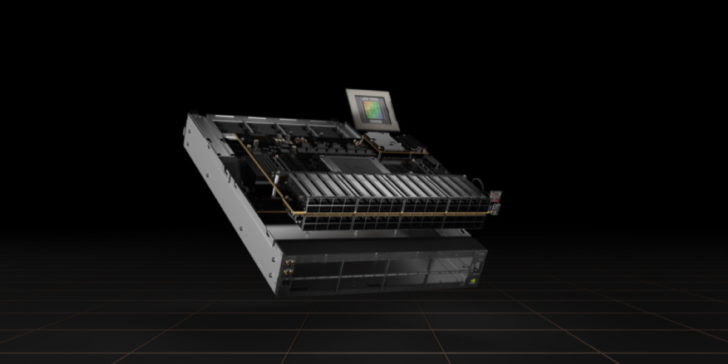
NVIDIA Spectrum-4, the world’s first end-to-end 400Gbps networking platform, provides 4x the switching capacity of previous generations at 51.2 terabits per moment. Consists of NVIDIA Spectrum-4 family of switches , NVIDIA ConnectX®-7 SmartNIC , NVIDIA BlueField®-3 DPU , and DOCA data center infrastructure software to power cloud-native applications at scale.
Built for AI, NVIDIA Spectrum-4 comes at a time when data centers are growing exponentially and demanding extreme performance, advanced security, and powerful features that enable high-performance advanced virtualization and simulation at scale. The Spectrum-4 Ethernet platform includes key features essential for the uncompromising requirements of these technologies.
Spectrum-4 switches enable nanosecond timing accuracy, which is a five to six orders of magnitude improvement over typical millisecond-based data centers. They also speed up, simplify and secure the network fabric with 2x faster bandwidth per port, 4x fewer switches, and 40% lower power consumption than the preceding generation.
Spectrum platform enables accurate simulation of space and time on the NVIDIA Omniverse platform for 3D design collaboration and simulation, and the Spectrum-3 switching fabric connects 32 OVX servers to form the OVX SuperPOD.
“A new era of large-scale cloud technologies like Omniverse requires a transformation of data center architecture,” said Kevin Deierling, vice president of Networking at NVIDIA. “The extreme performance and robust security of the Spectrum-4 platform will equip data centers to drive breakthrough discoveries that push the boundaries of what is possible for the benefit of society.”
NVIDIA Spectrum-4 Switch Performance and Innovation
The NVIDIA Spectrum-4 ASIC and SN5000 family of switches are based on a 4N process and contain over 100 billion transistors along with a simplified transceiver design that results in the best power efficiency and complete cost of ownership. With an aggregate ASIC bandwidth of 51.2Tbps supporting 128 ports of 400GbE, combined with enhanced adaptive routing and congestion control mechanisms, Spectrum-4 optimizes RDMA over converged Ethernet fabrics and dramatically speeds up data centers.
The Spectrum-4 ASIC features state-of-the-art security features such as MACsec and VXLANsec support, plus pre-configured secure boot via a hardware root of trust to help ensure the security and integrity of data streams. and network management.
With 12.8Tbps of encrypted bandwidth and these security features – also found on the BlueField-3 DPUs and ConnectX-7 SmartNICs – Spectrum-4 is the fastest and most secure end-to-end Ethernet networking platform in the world. market.
The Spectrum platform, including Spectrum, BlueField, and ConnectX switches, powers the performance and scalability of AI applications, digital twins, and cloud infrastructure, enabling the highest efficiency and availability for modern data centers.
The growing spectrum support ecosystem
The speed, security and functionality of the Spectrum platform is ideal for building next-generation data centers and is being adopted by a growing number of partners.
BlueField DPUs now offload and accelerate Red Hat OpenShift , including an end-to-end cloud-native architecture that integrates infrastructure and tenant clusters with deployment and automation tools capable of running complex workloads in containers.
BlueField is also central to VMware’s Project Monterey, which includes a collaboration between VMware and NVIDIA aimed at improving data center performance, manageability and security.
Select businesses can now get prompt access to VMware ‘s Project Monterey Beta with BlueField on NVIDIA LaunchPad . LaunchPad enables IT administrators to deploy data-driven applications for rapid testing and prototyping entire workflows on the same comprehensive stack.
The integration of BlueField-2 DPU with Palo Alto Networks VM-series next-generation virtual firewalls and Clever Traffic Offload service delivers best-in-class security innovation, resulting in up to a 5x performance increase . Sometimes in virtual firewalls for enterprise networks and service providers.
Spectrum platform accelerates next-generation data center network infrastructure for industry-leading customers and software providers including Akamai, Baidu, Canonical, CheckPoint, Criteo, DDN, F5, Kuaishou , NetApp, Nutanix , OVHcloud, Pure Storage, Pluribus Networks, Red Hat, StackPath, HUGE Data, VMware and WEKA, among others.
Major server manufacturers that integrate Spectrum switches into their systems include Hewlett Packard Enterprise, IBM, Lenovo, and Supermicro.
NVIDIA BlueField DPUs are offered in solutions from innovators such as ASUS, Atos, Dell Technologies, GIGABYTE, H3C, IBM, Inspur, Lenovo, Nettrix, Pluribus Networks, Quanta/QCT, and Supermicro.
The BlueField-3 DPU and Spectrum-4 switching systems will be available later this year. ConnectX-7 is now available.
Illustration (c) NVIDIA
The post New NVIDIA Spectrum Switches Sync in Nanoseconds, Instead of Microseconds appeared first on B6G.NET| for all information technology.
]]>The post Jensen Huang interviews Bob Metcalfe on the history, lessons learned, and future of Ethernet appeared first on B6G.NET| for all information technology.
]]>The first Ethernet specification was a radical, groundbreaking decision that led to the formation of IEEE 802. Few could have predicted the connectivity revolution this would enable – starting with PCs and networked peripherals, all the way to local area networks (LANs). ), client/server systems, the WAN (Wide Area Network) and global connectivity – not forgetting other advances such as wireless networks, high-speed data center networks and the Internet of Matters (IoT).
This interview reveals that the Ethernet journey still has a long way to go. Jensen Huang was really excited about the progress: “In a bizarre way, Bob, the Coronavirus has put huge pressure and a heavy focus on the internet and networking.” Bob, meanwhile, compared the 1980 standard to what’s happening today: “There’s no relation to the 2020 Ethernet standard. There’s been a lot of evolution over the 40 years.”
Jensen posited that in the future, “We’re going to have an application that partly runs in one data center, partly runs in another data center at the edge, and then partly runs on autonomous machines that roam all over the world.” the world”. He then referred to the path traveled from 2-D images to insight in virtual reality: “Today, thanks to your invention, Bob, we have the ability to share in different places… in the future we will be able to teleport to different spaces… the teleportation will happen. It will just be moving photons, not atoms.”
“Hearing Jensen Huang, or Bob Metcalfe, speak would be a gift in itself, but having the two of them together in dialogue is very exciting,” says Mark Fox, CEO of NetEvents, the event organizer. “Not only are they two of the greatest visionaries and inventors in technology, but they are also highly successful entrepreneurs sharing real business insights on the amazing success of Ethernet.”
The event included a panel discussion led by Tam Dell’Oro, founder and CEO of the Dell’Oro Group. Bob Metcalfe joined the discussion along with three other highly influential luminaries in driving the Ethernet industry – Nan Chen, President of the MEF; David Law, Chairman of the IEEE 802.3 Ethernet Working Group; and Brad Booth, President of the Ethernet Technology Consortium – a body further exploring the ongoing communications revolution made possible by the invention of Ethernet.
Topics discussed included: vendor innovation vs. commodification of standards; new Ethernet technologies like 800Gbps, optical switching, and quantum Ethernet – plus Bob’s new focus on power consumption and the need for a greener Ethernet. The event concluded with a live Q&A session with invited international IT and business media. Diario TI participated in the event.
The interview invites a really deep and evolving discussion,” says Tam Dell’Oro, “It started with Jensen, clearly excited to meet the inventor of Ethernet, eager to learn about the creative surroundings at Xerox PARC, what was needed and how Bob faced the challenge for the first time. We then listened to these two highly successful entrepreneurs share their experience of the challenges facing start-ups in an surroundings of established giants like IBM.”
They compared the motivational slogans that kept them going and, of course, the imperative role of industry standards. Jensen pointed to the expected decline of Moore’s Law and recognized the need for a new type of processor, one that would later prove necessary to the evolution of machine learning. And we end with two new friends sharing visions about the future of networks and the challenges of the IoT. There is so much valuable material here – this is definitely one to listen to again and again.”
Today’s full interview is available on the NetEvents website .
video of the event

The post Jensen Huang interviews Bob Metcalfe on the history, lessons learned, and future of Ethernet appeared first on B6G.NET| for all information technology.
]]>